


Why Change Fails | Paper 1
Organizations rarely fail to transform because they lack activity. More often, they fail because they were never designed to withstand the predictable pressures that large-scale change creates.
The roadmap exists. Governance is in place. Funding is approved. Milestones are green. Yet the business is not moving the way leaders expected. Teams are active without converging. Pilots are underway without scaling. Progress is being reported, but confidence is not increasing.
One executive described it to me this way: “It feels like youth soccer where everyone is kicking at the ball at the same time, but the ball still doesn’t move.”
That pattern shows up across cloud modernization, AI adoption, operating model redesign, customer transformation and broader business change. The surface details vary. The underlying failure patterns do not.
Across large-scale change efforts, the same five breakpoints tend to appear again and again. They are not random setbacks. They are predictable failure patterns that organizations often fail to design against, then fail to recognize early enough once they begin to surface.
Each breakpoint is a visible sign that one of the underlying forces of transformation has weakened: purpose, commitment, capability or momentum.
Leaders do not need another slogan about change. They need a way to design against predictable breakpoints before launch, then recognize the warning signs before drift becomes expensive.
1. Strategic Disconnection
The first breakpoint appears when a transformation is launched with broad intent but without enough precision to keep the organization aligned under real operating pressure. Leaders believe the strategy is clear, but the organization is operating from multiple versions of the outcome.
A healthcare organization launched a cloud transformation with visible executive support and strong early agreement. But each major stakeholder quietly interpreted the effort through the lens of their own function. Security processes would remain intact. Change windows would remain intact. Review paths would remain intact. No one openly resisted. No one had actually committed to the same destination.
A year later, the organization had new cloud platforms and an essentially unchanged operating model.
This is one of the most expensive failure patterns because it does not look like conflict at the start. It looks like consensus. That is what makes it dangerous: the organization has not aligned; it has only agreed not to disagree yet.
Leaders hear the same language repeated back to them and assume alignment exists. In practice, teams fill in the blanks with their own definitions, priorities and assumptions about what will or will not change.
The issue is not inspiration. It is precision.
A goal like “become more digital” or “use AI to improve customer experience” sounds aligned in a kickoff meeting and fragments in execution. A goal like “reduce customer resolution time by 40 percent within two quarters” gives teams a shared outcome they can translate into decisions, tradeoffs and accountability.
When strategic disconnection sets in, organizations do not usually stop moving. They simply begin moving in slightly different directions.
Self-check: If you asked ten leaders to describe the primary outcome of the transformation, would their answers actually match?
2. Incentive Fragmentation
The second breakpoint appears when a transformation depends on cross-functional cooperation but was never designed to align the incentives of the people whose decisions determine whether it moves. What looks like support early on often collapses once real tradeoffs appear.
A financial institution had a major migration effort underway with one deadline no one could ignore: datacenter leases were expiring. The VP of Data had aligned teams, built the business case and set the timeline. The CISO attended the planning meetings and raised no visible objection. Months later, he revealed that he had engaged a separate consulting partner, defined a different set of security requirements and that nothing would move until his scorecard was satisfied.
The cloud was not the problem. The program stalled because one executive with veto power had little reason to optimize for migration success. His job was to ensure security was never the cause of failure. Migration speed was not his metric.
This is where many leaders misread commitment. They interpret attendance as buy-in. It often means awareness. Sometimes it means observation. In this case, it was reconnaissance.
Incentive fragmentation is especially dangerous because teams often look productive while the system is quietly pulling them apart. One leader is measured on speed. Another on cost containment. Another on risk reduction. Another on quarterly output. Everyone works hard. The enterprise does not move coherently.
The issue is not whether leaders verbally support the change. It is whether the system makes it rational for them to prioritize it when tradeoffs appear.
If a transformation succeeds while a powerful stakeholder’s metrics stay flat or worsen, leaders should not be surprised when resistance shows up in delay, exceptions, side processes or alternative standards. Those responses are not random. They are the natural consequence of a system that was never aligned to move together.
Self-check: If the transformation succeeds but a leader’s metrics do not improve, will that leader still treat the work as a priority?
3. Process Friction
The third breakpoint appears when leaders set a faster ambition without redesigning the operating model required to support it. The strategy changes. The machinery does not.
A retail organization invested in cloud capabilities that could technically provision a working application environment in hours. But launching an application still required sequential handoffs across operating system, network, storage, identity, database, application, backup, monitoring and security teams. Each group had its own queue. Each worked on its own timeline. No one owned the full journey from request to result.
The cloud could move in hours. The organization still moved in weeks.
This is where many transformation efforts lose credibility with the people doing the work. Leaders announce a new ambition, but the underlying machinery remains unchanged. The handoffs are the same. The approvals are the same. The decision rights are the same. The dependencies are the same. Teams are told to move faster inside a system designed to prevent speed.
What makes this breakpoint so persistent is that organizations often overestimate capability by looking at talent rather than flow. They have skilled people. They have good technology. They may even have committed leaders. What they do not have is a delivery system that allows those ingredients to produce consistent business movement.
When process friction dominates, the strategy is not actually being executed. It is being negotiated one handoff at a time.
This is also where leadership credibility gets tested. Teams quickly learn whether transformation language is going to be backed by structural redesign or whether they are simply being asked to absorb more pressure inside the same constraints.
Self-check: If you mapped how work actually flows today, would it look like the formal process or the workaround your teams built to survive it?
4. The Technology Illusion
The fourth breakpoint appears when leaders invest in a new capability without designing the surrounding behaviors, workflows and decision norms required to make it valuable.
An enterprise software company invested in a new sales analytics platform. The data was better. The dashboards were better. The engineering work was solid. Months later, teams were still relying on legacy reports and spreadsheets.
Not because the new system was inaccurate or harder to use. Because the old process gave people more room to tune the story, soften the numbers or avoid difficult conversations.
The technology was ready. The organization was not.
This pattern is common in AI, analytics, workflow automation and broader modernization programs. Leaders invest in the visible artifact and underestimate the operational and behavioral change required to make it valuable. They hope the tool will force the organization forward. More often, the organization absorbs the tool into its existing habits and continues operating much as before.
Technology can accelerate aligned execution. It cannot create alignment on its own.
That is why so many well-funded initiatives look compelling in demonstrations and disappoint in practice. The technical capability becomes visible before the operating discipline required to use it. By the time leaders see weak adoption or shallow impact, the real problem has usually been present for months in unchanged incentives, decision habits, workflows and management behavior.
This is not a technology failure. It is a leadership design failure. The organization was asked to use a new tool inside an old operating system.
Self-check: If you removed the technology tomorrow, would teams still agree on how the work should happen?
5. Momentum Mirage
The fifth breakpoint appears when a transformation is launched with early visibility but without enough built-in reinforcement to sustain progress once leadership attention shifts.
A semiconductor company launched a digital transformation with strong executive attention and promising early wins. The first quarterly review looked strong. Pilots were working. Teams were engaged. Progress was visible. Then margin pressure pulled the executive sponsor into other priorities. Governance meetings remained on the calendar. Status reports continued. But decision velocity slowed, obstacles stayed unresolved longer and visible reinforcement faded.
No one cancelled the initiative. No one needed to. The organization simply stopped feeding it.
By the next planning cycle, the transformation was still alive in presentations and largely dead in practice.
This breakpoint is easy to miss because activity continues after momentum has weakened. Meetings happen. Slides update. The work still has a name. What disappears is the force that turns progress into confidence and confidence into adoption. People begin reading silence as a signal. They return to local priorities. The old system starts reclaiming ground.
Momentum is not enthusiasm. It is the organization’s ability to convert intent into visible progress, then reinforce that progress fast enough to sustain belief.
The leaders who manage this well do not wait for annual reviews to discover drift. They create short feedback loops, make wins visible, remove friction quickly and stop weak experiments before they consume confidence along with resources.
Transformations that survive leadership distraction, budget pressure or competing priorities are rarely the ones with the best launch. They are the ones designed with enough reinforcement to keep moving once the spotlight shifts.
Self-check: What would happen if you stopped actively managing this transformation for 90 days?
What These Breakpoints Are Actually Revealing
These five breakpoints are not random execution problems. They are visible signs that the transformation was not designed strongly enough in one or more of four underlying forces, and that leaders are now seeing the consequences in execution.
Purpose. Is the outcome clear enough that teams would define success the same way?
Commitment. Have priorities, incentives, ownership, and resources been aligned strongly enough to hold when tradeoffs appear?
Capability. Does the organization have the operating ability to execute and scale, not just the technical talent to begin?
Momentum. Is there enough visible progress, reinforcement, and feedback to sustain movement after launch?
These are not meant to replace every other change model. Leaders already have plenty of frameworks that describe what change should include. The value here is practical. These four forces help leaders do two things better: design transformations that are more likely to hold under pressure and recognize early when force is being lost.
Strategic disconnection usually points to weak purpose. Incentive fragmentation exposes weak commitment. Process friction and the technology illusion both reveal capability gaps, but in different ways. Process friction lives in how work flows across teams. The technology illusion reveals a capability gap rooted not in broken workflow but in the belief that the right technology can substitute for organizational readiness. Momentum mirage is what happens when reinforcement and decision energy fade before the organization has truly shifted.
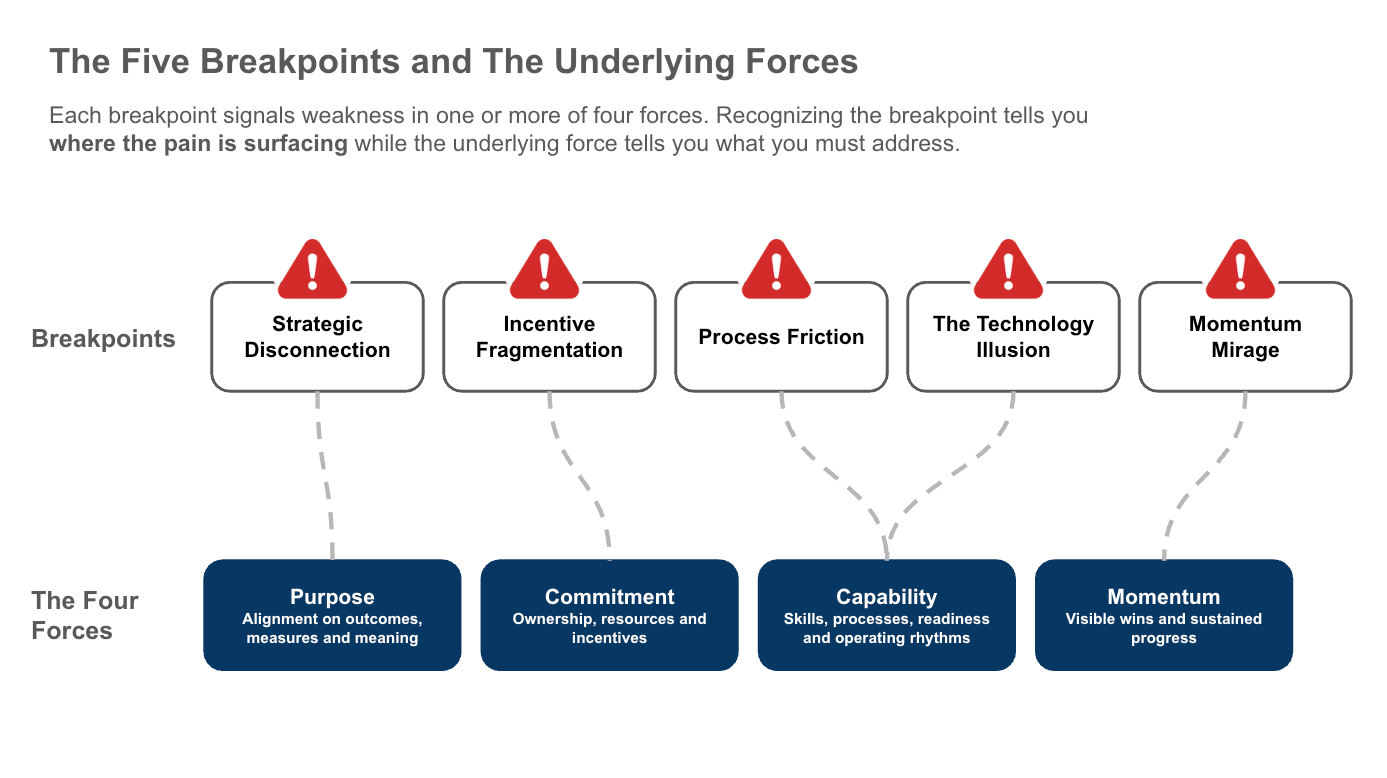
The breakpoint tells leaders where the pain is surfacing. The underlying forces help explain what must change.
A Practical Diagnostic for Leaders
When transformations begin to stall, leadership teams often respond by adding governance, increasing communication or introducing more tooling. Those actions may help, but they are often treatments applied after deeper design weaknesses have already surfaced.
A better starting point is to ask four questions before the work scales and then ask them again as it progresses.
Purpose: Are we aligned on the outcome, and would teams describe success the same way?
Commitment: Have we aligned incentives, ownership and priorities strongly enough to survive conflict?
Capability: Does our operating model allow the work to move at the speed the strategy now requires?
Momentum: Have we built enough visible progress and short enough feedback loops to sustain confidence and action after launch?
Used early, these questions help leaders design against predictable breakpoints. Used later, they help identify where drift is already forming.
The goal is not to create a perfect scorecard. The goal is to make hidden weakness discussable while it is still manageable.
That is where many transformations fail. Leaders can feel the energy draining, but they cannot yet name the mechanism. Once the issue is named, it becomes actionable. An unclear outcome can be sharpened. A misaligned incentive can be redesigned. A broken handoff can be rebuilt. A weak feedback loop can be tightened.
But that only happens when leaders stop treating symptoms as the root cause and start asking whether the transformation was built to hold under the realities of how the organization actually works.
The Leadership Work Behind Every Transformation
Most organizations are not short on ambition. They are short on aligned execution.
That challenge is getting harder as companies layer AI adoption, operating model redesign, cost pressure and higher performance expectations on top of one another. In that environment, transformations do not fail because leaders lack effort. They fail because the organization was not designed to hold alignment, incentives, capability and momentum under real operating pressure, and because the warning signs are often recognized too late.
The real work of leadership is not just to launch change. It is to build and sustain the forces that allow change to hold, then see early when those forces are weakening.
That is why the best transformation leaders do more than sponsor programs. They clarify outcomes. Align incentives. Remove structural friction. Build reinforcement into the system. Watch for early signs of drift. They do not just ask whether the initiative is on track. They ask whether the organization is becoming more able to deliver what the business now needs.
That starts with one honest question:
Can you tell, right now, whether this transformation was designed to succeed?
The question is not whether the transformation is active. The question is whether it was designed to hold under pressure, and whether leaders can see the warning signs before activity becomes a substitute for movement.
This is Paper 1 in the Why Change Fails series
Very thoughtful, and spot-on. We have seen these patterns over and over. It's remarkable that for as often (and as long) as we've seen them, and as organizations struggle to diagnose and course-correct, these detours and missteps still happen. This should be required reading for any enterprise leader about to undertake a new technology strategy with a view toward "transforming" the company.
This really resonates. I’ve seen firsthand how easy it is for organizations to confuse activity with progress—plenty of motion, but no real convergence.
The point about technology hit home too—tools don’t transform organizations, people and operating models do. Without changing how work actually flows and how decisions get made, new capabilities just get absorbed into old habits.